If you’ve ever sat down to plan your healthcare marketing strategy for the year and thought, “What should we even be posting or promoting right now?”—you’re not alone.
Most dental and medical practices don’t struggle with doing marketing. They struggle with consistency and timing. Campaigns get rushed, ideas run dry, and opportunities tied to key dates slip by unnoticed.
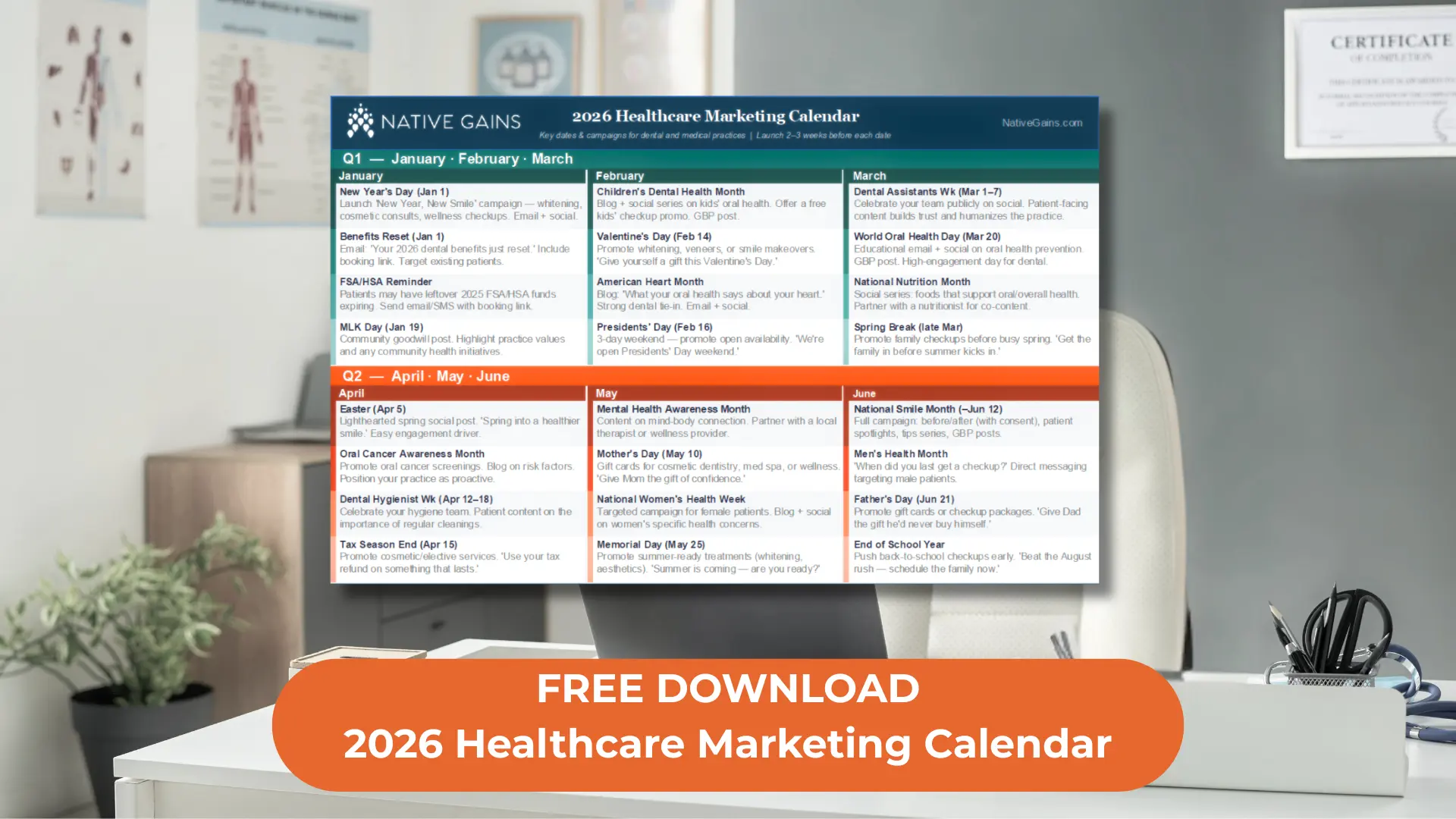
That’s exactly why we created a simple, one-page 2026 Healthcare Marketing Calendar. It’s designed to give dental and medical practices a clear roadmap of what to focus on each month without overcomplicating things.
Here’s how to think about your marketing in 2026, and where this kind of structure makes a difference.
Why Most Practice Marketing Feels Inconsistent
In many practices, marketing happens in bursts. A promotion here, a few social posts there, maybe an email when the schedule looks light.
The problem isn’t effort. It’s the lack of a system.
Without a calendar tied to real healthcare practice marketing strategy and seasonal trends, it’s easy to:
- Miss high-intent moments (like benefits resets or year-end deadlines)
- Post content that doesn’t connect with what patients are thinking about
- Fall behind during busy periods and go silent when visibility matters most
A structured calendar solves that by giving your team direction before the month even starts.
The Power of Timing Your Campaigns
One of the biggest advantages of using a marketing calendar is alignment with how patients actually make decisions throughout the year.
Certain moments consistently drive action:
- January: Patients are thinking about fresh starts and newly reset benefits
- Spring: Families begin planning around schedules, travel, and upcoming events
- Late summer: Back-to-school and routine care come back into focus
- Year-end: Urgency peaks around expiring benefits and unused funds
When your campaigns line up with these patterns, marketing feels more natural and performs better.
What a Well-Planned Marketing Year Looks Like
Instead of guessing month to month, a strong plan maps out your year across all four quarters.
Q1: Start Strong and Capture Early Demand
The beginning of the year is one of the most important windows for patient engagement.
Practices often focus on:
- “New Year, New Smile” or wellness campaigns
- Benefits reset messaging
- Preventive care and education tied to awareness months
It’s also a time to reconnect with existing patients before schedules fill up.
Q2: Build Momentum and Visibility
Spring and early summer are ideal for education and relationship-building.
Common opportunities include:
- Health awareness campaigns
- Family-focused messaging
- Seasonal promotions tied to events like Mother’s Day or graduation
This is where consistent content helps position your practice as the go-to provider in your area.
Q3: Fill Gaps and Prepare for the Fall Push
Summer can slow down for many practices, which makes it a good time to be proactive.
Strategies often include:
- New patient offers to keep schedules full
- Back-to-school campaigns
- Reactivation efforts for inactive patients
It’s also the time to start preparing for Q4, not reacting to it.
Q4: Maximize Urgency and Close the Year Strong
The final quarter is where many practices see a surge in demand.
Key focus areas include:
- Benefits and FSA/HSA deadlines
- Open enrollment messaging
- Holiday promotions and year-end scheduling
Practices that plan ahead here tend to outperform those that wait until November to act.
Don’t Overlook the Monthly Basics
While big campaigns matter, consistent execution month to month is what keeps your marketing working.
At a minimum, practices should be doing things like:
- Requesting and responding to patient reviews
- Posting regularly on Google Business Profile
- Sending at least one patient email or newsletter
- Monitoring ad performance and adjusting as needed
- Keeping business information accurate and up to date
These small actions compound over time and support every larger campaign you run.
Where Most Practices Get Stuck
Even with good ideas, execution is where things tend to fall apart.
Common challenges include:
- Not knowing what to promote next
- Running out of content ideas
- Inconsistent posting or communication
- Using disconnected tools that don’t work together
That’s where having a clear, structured calendar becomes valuable. It removes the guesswork and gives your team something to follow.
A Simpler Way to Plan Your 2026 Marketing
The 2026 Healthcare Marketing Calendar was built to make planning easier.
Inside, you’ll find:
- Key dates and campaign ideas across all four quarters
- Month-by-month suggestions tied to holidays and seasonal trends
- Practical ideas for email, social media, Google Business Profile, and SMS
- A simple checklist of monthly marketing essentials
It’s designed to be something you can reference quickly and actually use, not just another document that sits in a folder.
How Native Gains Supports Practice Growth
At Native Gains, we work with dental and medical practices that want marketing to feel more predictable and less reactive.
That often means:
- Building a clear healthcare email marketing and automation strategy for your practice
- Creating and managing campaigns tied to real patient behavior
- Handling content, email, SEO, and paid ads in a coordinated way
- Making sure nothing important falls through the cracks
Some practices use the calendar to guide their internal team. Others rely on us to execute it.
Final Thoughts
Marketing doesn’t have to feel scattered or last-minute. With the right structure, it becomes a steady system that keeps your schedule full and your practice visible year-round.
If you want a straightforward way to map out your marketing for the year, download the 2026 Healthcare Marketing Calendar. It will give you a clear starting point and help you stay consistent from January through December.
If you’d rather have support putting it into action, Native Gains can help you build and manage a marketing system tailored to your practice.
Teams building the annual plan can coordinate campaigns through healthcare digital advertising and specialized med spa and aesthetic clinic marketing.