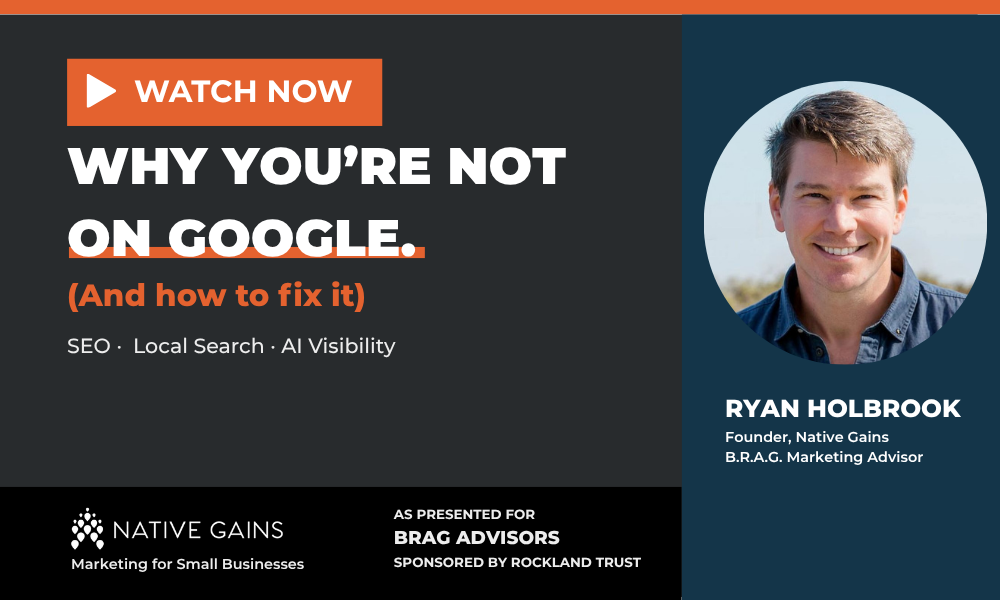
If you’ve Googled your own business and can’t find yourself, you’re not alone. It’s the single most common question I hear from small business owners. The short answer is that you’re probably missing one of four foundational SEO pieces. The longer answer is in the video below, plus everything you need to start fixing it this week.
Want the full webinar replay, the slide deck, and the 8-point SEO checklist as a PDF?
Drop your email and I’ll send all three to your inbox.
Originally presented for BRAG Advisors on May 20, 2026, sponsored by Rockland Trust.
The short answer
Your business isn’t showing up on Google for one (or more) of these reasons:
- Your Google Business Profile isn’t fully optimized, verified, or claimed
- Your website isn’t optimized for the specific keywords your customers actually search
- Your business information (name, address, phone) isn’t consistent across the web
- You don’t have enough authority signals like reviews, backlinks, and citations
Fix those four things and you’ll show up. The rest of this post and the video explain exactly how.
The anatomy of a Google search results page
Before you can fix your visibility, you need to understand where your business should appear. A modern Google results page has four distinct zones, and each one is its own SEO strategy:
- AI Overview at the top – Google’s AI-generated answer pulled from across the web
- Sponsored ads – paid Google Ads placements
- The local 3-pack – the map and three local business listings (powered by Google Business Profile)
- Organic results – traditional website rankings based on SEO
Most small business owners try to optimize for one zone and ignore the others. The businesses that dominate local search show up in multiple zones simultaneously.
The 4 reasons your small business isn’t showing up on Google
Real small business SEO has four pillars. Think of them like the parts of a car. If any one is missing, you don’t move.
1. Technical SEO (the engine)
This is the stuff under the hood: site speed, mobile responsiveness, URL structure, schema markup, indexability. If your site is slow, broken on mobile, or invisible to Google’s crawlers, no amount of content will save you. Most cheap SEO services skip this entirely.
2. Content (the fuel)
Every page on your site needs to be optimized for one clear target keyword. That means the keyword belongs in your URL, title tag, meta description, H1, image alt text, and naturally throughout the body. Keyword stuffing hurts you. Strategic keyword targeting wins.
3. Authority (your driving record)
Google needs proof you’re who you say you are. That comes from:
- A fully completed Google Business Profile
- Consistent name, address, and phone number (NAP) across every directory
- Real reviews from real customers
- Natural backlinks from credible local or industry sources
Inconsistent NAP is one of the most common reasons local businesses don’t rank.
4. Tracking (the dashboard)
You can’t optimize what you don’t measure. The free Google stack covers most small businesses:
- Google Analytics 4 (what people do on your site)
- Google Search Console (what Google sees when it crawls your site)
- Google Tag Manager (the container that holds all your tracking code)
Without these, you’re flying blind.
How to fix it: a small business SEO checklist
Here’s what to do this week, in order of impact:
- Google your own business the way a stranger would. Search “[your service] in [your city].” Note where you appear (or don’t) and what competitors are showing up
- Claim and optimize your Google Business Profile. Fill out every field. Add 10+ real photos. Be specific about services and service areas
- Audit your title tags, meta descriptions, and H1s on every page. Each page should target one specific keyword
- Make sure your NAP is identical on every directory you appear in (Yelp, Bing, Apple Maps, Facebook, industry-specific listings)
- Set up Google Analytics 4 and Search Console if you haven’t already
- Test your mobile experience. Most small business sites have at least one mobile usability issue
- Ask 3 happy customers for a Google review this week and reply to every existing review you have
- Publish one new piece of content targeting a specific question your customers ask
Want this checklist as a printable PDF, plus the full 45-minute webinar where I walk through each step with real examples?
Send it to Me →
Before choosing the next investment, review our client case studies to see how visibility improvements connect to business results.
How to show up in AI search results
AI search visibility is the newest piece of the puzzle, but the fundamentals are the same. ChatGPT, Gemini, Claude, and Google’s AI Overview pull from authoritative, well-structured web content. If you’re doing small business SEO right, you’re already doing AI search right.
The specific moves that boost AI visibility:
- Add FAQ-style sections to your service pages (AI loves question-and-answer format)
- Implement structured data (schema markup) so AI bots can categorize your content
- Maintain consistent business info across all directories
- Lead with clear, direct answers (AI quotes are short and direct)
How long does small business SEO take to show results?
SEO is not a campaign. It’s a long-term asset. Here’s the honest timeline:
- Months 1-2: Foundation work. Tracking, technical fixes, Google Business Profile, baseline content
- Months 3-6: Initial growth. Pages start ranking. Impressions and clicks climb
- Months 6-12: Compounding. Authority builds. Rankings stabilize. Real leads start flowing
- Year 2+: The compounding really kicks in. SEO becomes your most cost-effective channel
The owners who give up at month four miss the entire payoff. The ones who stay consistent end up with leads they don’t have to pay per click for.
Real small business SEO results
A few examples from my agency:
- Paradise Dental (Salem, MA): 150%+ growth two years running through SEO and Google Ads
- Optimal Dermatology (multi-location, Eastern US): Significantly lower cost per lead with higher conversion rates
- Commercial landscaper, North Shore MA: Service-page strategy that ranks organically and lowered paid ad cost-per-click
These weren’t shortcuts. They came from fixing the foundation and staying consistent.
Frequently asked questions
How long does SEO actually take to show results? Three to six months for initial movement, six to twelve months for real compounding. SEO works like fitness, not like a sprint. Consistency wins.
What’s the most impactful thing I can do this week with no budget? Optimize your Google Business Profile. Fill out every field, add real photos, be specific about services, and ask happy customers for reviews. For most local businesses, this is the first thing prospects see and it’s completely free.
Can AI tools just do SEO for me? Not yet. AI can analyze, suggest, and help you write content faster, but it can’t fix your technical SEO, build backlinks, or manage your Google Business Profile. Tools that claim to do “complete SEO” for $99/month are selling one piece of the puzzle.
How is AI search changing SEO? The fundamentals haven’t changed. Clean structured content, consistent business info, FAQ-style answers, and schema markup all help you show up in both Google and AI tools like ChatGPT, Gemini, and Google’s AI Overview. Optimize once, win in both places.
Do I really need to ask every customer for a review? You don’t have to ask every customer, but every review helps. Build it into your follow-up process. Spread requests out over time rather than batching them. Reply to every review, positive or negative, professionally.
My website is a few years old. Do I need a new one to do SEO? Not necessarily. Older domains have authority advantages. If the site loads fast, works on mobile, and is structured well, you can absolutely rank with it. Age is an asset. Bad technical foundation is the problem.
What should I budget for small business SEO? For a self-managed approach, your main cost is time. To hire a real agency that handles all four pillars, expect a few hundred dollars per month at minimum, scaling up based on competitiveness and growth goals.
How does SEO work with Google Ads? They compound. A page that ranks organically also serves as a high-quality landing page for ads, which lowers your cost per click. The best small business marketing strategies use both together.
Want the full toolkit?
Get the webinar replay, the slide deck, and the 8-point checklist as a PDF. One email, three resources.
Ready for a second set of eyes?
I do free SEO audits for small business owners. I’ll Google your business the way a stranger would, review your Google Business Profile, scan your site against the checklist, and tell you exactly where to start.
Book your free SEO audit →
No pitch. No commitment. Just a clearer picture of what’s working and what isn’t.
About NativeGains
NativeGains is a digital marketing and website agency for small businesses. We work across industries with a particular focus on healthcare practices. Our team handles strategy, execution, and the technical work most owners don’t have time to learn themselves. Month-to-month, no long-term contracts.